| World | Longterm | Midterm | Shorterm |
| S&P500 | Down | Down | Neutral (+) |
| DJI | Down | Down | Neutral (+) |
| NasdaqComp | Down | Down | Neutral (+) |
| Nikkei 225 | Down | Down | Down |
| Kospi | Down | Down | Down |
| SSECI | Down | Down | Down |
| HSI | Down | Down | Down |
| TWII | Down | Down | Down |
| STI | Down | Down | Down |
| SENSEX | Down | Down | Down |
| FTSE | Down | Down | Neutral (+) |
| DAX | Down | Down | Neutral (+) |
Monday, November 03, 2008
World Market (20081031)
Asian markets are still pointing down. The US seems to have stabilized but it was the end of month, so some funds may have done some window dressing. The selling pressure seems to have subsided but this may be the calm before the next storm.

Saturday, November 01, 2008
KLCI (31 Oct 2008)
 KLCI Monthly Chart
The support at around 800 has been tested and is still holding. It may rebound to the 930-980 region. If the 800 level is broken, then the next support is at 550 to 650.
Major KLSE sectors are still bearish:
| Malaysia | Longterm | Midterm | Shorterm |
| KLCI | Down | Down | Down |
| Finance | Down | Down | Down |
| Construction | Down | Down | Down |
| Plantation | Down | Down | Down |
| Property | Down | Down | Down |
| Mesdaq | Down | Down | Down |
| 2nd Board | Down | Down | Down |
Cheap Sales (10): Property
 Property Sector Index
16 years of bear market! The index value is currently at support level. If this fails, the next one will be at 400.
 KLCCP Monthly Index
This one still looks strong. Technically, it has broken its uptrend line support and the next possible support is at 2.30.
 Mahsing Monthly Chart
This one also looks strong. I thought of playing the rebound game but back off due to bad market sentiment. Next possible support is at 1.00.
 SPSetia Monthly Chart
The next possible support is at 2.50.
 Suncity Monthly Chart
The next possible support is at 1.30.
 Sunrise Monthly Chart
Tested the final uptrend line support and still holding. If this fails, then the next possible support is at 0.70.
Cheap Sales (9): Oil & Gas
I really don't understand how this people think or analyze. Aseambankers has downgraded the oil and gas sector to underweight on Friday (Oct 31, 2008). They did it after the sector has loss 50 to 80 % of value from the peak! Errr...should you give us a much earlier warning?
 Dialog Monthly Chart
Tested the uptrend line at 0.50.
 Kencana Weekly Chart
Moving within a downtrend channel.
 KNM Monthly Chart
What happened to this industry's darling? Tested its uptrend line at 0.40.
 Muhibah Monthly Chart
Broken its uptrend line. Tested the support at around 0.65. If this fails, then the next possible support is at 0.25.
 Penergy Weekly Chart
Still in downtrend. No idea where is the support.
 Petra Monthly Chart
Broken its uptrend line. Next possible support is 1.00.
 Sapcres Monthly Chart
Uptrend line at 0.60 seems to be holding after some panic selling. If this breaks, the next possible uptrend line support is at 0.30.
 Waseong Monthly Chart
Broken its uptrend line. Next possible support is at 0.85.
Summary: All O&G counters are still in bear mode. No base building or reversal signal seen. Rebound should happen as they have been very oversold.
 Dialog Monthly Chart
 Tested the uptrend line at 0.50.
 Kencana Weekly Chart
 Moving within a downtrend channel.
 KNM Monthly Chart
 What happened to this industry's darling? Tested its uptrend line at 0.40.
 Muhibah Monthly Chart
 Broken its uptrend line. Tested the support at around 0.65. If this fails, then the next possible support is at 0.25.
 Penergy Weekly Chart
 Still in downtrend. No idea where is the support.
 Petra Monthly Chart
 Broken its uptrend line. Next possible support is 1.00.
 Sapcres Monthly Chart
 Uptrend line at 0.60 seems to be holding after some panic selling. If this breaks, the next possible uptrend line support is at 0.30.
 Waseong Monthly Chart
 Broken its uptrend line. Next possible support is at 0.85.
Summary: All O&G counters are still in bear mode. No base building or reversal signal seen. Rebound should happen as they have been very oversold.
Cheap Sales (8): Airline
 AirAsia Monthly Chart
Still in downtrend. Should challenge the previous low of 0.76.
 MAS Monthly Chart
Resting at its uptrend line. If this breaks, the next possible support is at 2.40.
Cheap Sales (7): Shipping
 Maybulk Monthly Chart
Looks like going back to square one. Supports: 1.90 (an uptrend line that is not shown in the chart above because I forgot to draw it and I'm lazy to upload the file for the 2nd time) and 1.60.
 MISC Weekly Chart
This is a boring counter. Volume is very low. Next possible supports: 7.20 and 6.00.
Cheap Sales (6): Power
 Tenaga Monthly Chart
Uptrend broken. Next possible supports: 4.50 and 1.60. If USD continues to rise, this stock is going to get toasted.
 YTLPowr Monthly Chart
Uptrend broken. Next possible supports: 1.45 and 1.00.
Friday, October 31, 2008
Cheap Sales (5): Telco
 Digi Monthly Chart
Resting at one of the uptrend line. Next possible support: 16.50.
 TM Monthly Chart
Uptrend still intact but weakening. Possibly a double top at 3.70. Possible supports: 3.20 and 2.70
 TMI Daily Chart
In downtrend. In uncharted territory. No idea where are the supports.
Cheap Sales (4): Plantation
This is just plain scary. So fast, so much.
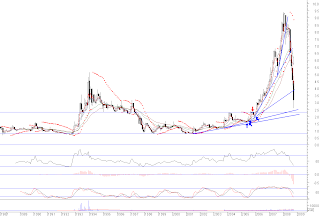
 Plantation Sector Index Monthly Chart
In 4 months it losses 60%. Hit possible support at 3000. No reversal in sight.
 Asiatic Monthly Chart
Possible supports: 2.50 and 2.20.
 IOICorp Monthly Chart
Possible supports: 2.40, 1.90 to 2.10 and 1.30.
 KLK Monthly Chart
Possible supports: 7.00 and 5.50.
 Kulim Monthly Chart
Possible supports: 3.00 to 3.10 and 2.00 to 2.30.
 Plantation Sector Index Monthly Chart
In 4 months it losses 60%. Hit possible support at 3000. No reversal in sight.
 Asiatic Monthly Chart
Possible supports: 2.50 and 2.20.
 IOICorp Monthly Chart
Possible supports: 2.40, 1.90 to 2.10 and 1.30.
 KLK Monthly Chart
Possible supports: 7.00 and 5.50.
 Kulim Monthly Chart
Possible supports: 3.00 to 3.10 and 2.00 to 2.30.
Thursday, October 30, 2008
Cheap Sales (3): Construction
Strong rally today. The trend is still down. How high can the bounce go? I'm very bad in playing this bouncing game. That is why I'm still staying out.
 Construction Sector Monthly Chart
Uptrend line broken. Should find support at 120 level.
 Gamuda Monthly Chart
Broken the uptrend line. Possible supports: 1.00-1.10 and 0.40.
 IJM Monthly Chart
Uptrend line broken. Possible supports: 2.40, 1.90, 1.30 and 0.60.
 WCT Monthly Chart
Still above its uptrend line. Possible supports: 1.00 and 0.80.
 Construction Sector Monthly Chart
Uptrend line broken. Should find support at 120 level.
 Gamuda Monthly Chart
Broken the uptrend line. Possible supports: 1.00-1.10 and 0.40.
 IJM Monthly Chart
Uptrend line broken. Possible supports: 2.40, 1.90, 1.30 and 0.60.
 WCT Monthly Chart
Still above its uptrend line. Possible supports: 1.00 and 0.80.
Cheap Sales (2): Gambling
 BJToto Monthly Chart
Looks resilient. Just starting to drop. Possible supports: 4.00, 3.60.
 Genting Monthly Chart
Getting crushed like the US casinos? Possible supports: 3.60, 3.00, 2.50.
 MPHB Monthly Chart
Almost flat if compared to 1993. Possible support: 0.90.
 Resorts Monthly Chart
One more uptrend line to go. Possible supports: 2.20, 2.00, 1.70.
Wednesday, October 29, 2008
Cheap Sales (1): Banks
 Finance Sector Index Monthly Chart
Dropping from a cliff. Next possible support is at 5000.
 AMMB Monthly Chart
Uptrend line broken. Possible supports: 1.80, 1.30.
 Commerz Monthly Chart
Approaching its last uptrend line.
 HLBank Monthly Chart
Uptrend line broken. Only starting to break down. Possible supports: 4.00, 3.00.
 Maybank Monthly Chart
At possible support point of 5.00. Next are 3.50 and 2.50.
 PBBank Monthly Chart
Resting on its uptrend line. Next possible support is around 6.50 to 7.00. Technically, this is the strongest among the banks.
 RHBCap Monthly Chart
Resting at its uptrend line.
Based on the monthly chart's RSI reading, it seems that all the banks can fall some more because the monthly RSI is not oversold yet. In the 1997 crisis, the RSI managed to go under 30 before the prices recover. You can also notice that a bottom takes about 6-12 months to form. So don't worry that you have missed it. It is best to pay 10% more for a sure bottom than catching a falling knife.
Monday, October 27, 2008
Crash This Week?
This is the final week of October. As you know, October is never a good month for equities. The world is still deleveraging. Oil down, gold down. If you look at the Hong Kong market today, you will be very afraid. With so many souls have been bruised, it will definitely takes time for the market to recover. I do not expect a V-shape recover, I think that it will be a W-shape or maybe L-shape that will take years.
For KLSE, everything is down. Companies with high USD exposure is suffering now. I'm still staying out of the market. Why? Investors have not given up hope yet. They are still trying to pick the bottom. I think that when they stop picking bottom because every possible bottoms have given away, then that may be the time.
Sunday, October 19, 2008
The Gotrocks
I came across this article from another blog, who extracted it from Warren Buffett 2005 letter to his shareholder. I find it really interesting. It's about brokers, mutual fund, hedge fund and private equity. I reproduce it here:
$$$$$$$$$$$$$$$$$$$$$$$$$$$$$$$$$$$$$$$$$$$
To understand how this toll has ballooned, imagine for a moment that all American corporations are, and always will be, owned by a single family. We’ll call them the Gotrocks. After paying taxes on dividends, this family – generation after generation – becomes richer by the aggregate amount earned by its companies. Today that amount is about $700 billion annually. Naturally, the family spends some of these dollars. But the portion it saves steadily compounds for its benefit. In the Gotrocks household everyone grows wealthier at the same pace, and all is harmonious.
But let’s now assume that a few fast-talking Helpers approach the family and persuade each of its members to try to outsmart his relatives by buying certain of their holdings and selling them certain others.
The Helpers – for a fee, of course – obligingly agree to handle these transactions. The Gotrocks still own all of corporate America; the trades just rearrange who owns what. So the family’s annual gain in wealth diminishes, equaling the earnings of American business minus commissions paid. The more that family members trade, the smaller their share of the pie and the larger the slice received by the Helpers. This fact is not lost upon these broker-Helpers: Activity is their friend and, in a wide variety of ways, they urge it on.
After a while, most of the family members realize that they are not doing so well at this new “beat my- brother” game. Enter another set of Helpers. These newcomers explain to each member of the Gotrocks clan that by himself he’ll never outsmart the rest of the family. The suggested cure: “Hire a manager – yes, us – and get the job done professionally.” These manager-Helpers continue to use the broker-Helpers to execute trades; the managers may even increase their activity so as to permit the brokers to prosper still more. Overall, a bigger slice of the pie now goes to the two classes of Helpers.
The family’s disappointment grows. Each of its members is now employing professionals. Yet overall, the group’s finances have taken a turn for the worse. The solution? More help, of course. It arrives in the form of financial planners and institutional consultants, who weigh in to advise the Gotrocks on selecting manager-Helpers. The befuddled family welcomes this assistance. By now its members know they can pick neither the right stocks nor the right stock-pickers. Why, one might ask, should they expect success in picking the right consultant? But this question does not occur to the Gotrocks, and the consultant-Helpers certainly don’t suggest it to them.
The Gotrocks, now supporting three classes of expensive Helpers, find that their results get worse, and they sink into despair. But just as hope seems lost, a fourth group – we’ll call them the hyper-Helpers – appears. These friendly folk explain to the Gotrocks that their unsatisfactory results are occurring because the existing Helpers – brokers, managers, consultants – are not sufficiently motivated and are simply going through the motions. “What,” the new Helpers ask, “can you expect from such a bunch of zombies?”
The new arrivals offer a breathtakingly simple solution: Pay more money. Brimming with self-confidence, the hyper-Helpers assert that huge contingent payments – in addition to stiff fixed fees – are what each family member must fork over in order to really outmaneuver his relatives.
The more observant members of the family see that some of the hyper-Helpers are really just manager-Helpers wearing new uniforms, bearing sewn-on sexy names like HEDGE FUND or PRIVATE EQUITY. The new Helpers, however, assure the Gotrocks that this change of clothing is all-important, bestowing on its wearers magical powers similar to those acquired by mild-mannered Clark Kent when he changed into his Superman costume. Calmed by this explanation, the family decides to pay up.
And that’s where we are today: A record portion of the earnings that would go in their entirety to owners – if they all just stayed in their rocking chairs – is now going to a swelling army of Helpers. Particularly expensive is the recent pandemic of profit arrangements under which Helpers receive large portions of the winnings when they are smart or lucky, and leave family members with all of the losses – and large fixed fees to boot – when the Helpers are dumb or unlucky (or occasionally crooked). A sufficient number of arrangements like this – heads, the Helper takes much of the winnings; tails, the Gotrocks lose and pay dearly for the privilege of doing so – may make it more accurate to call the family the Hadrocks.
Today, in fact, the family’s frictional costs of all sorts may well amount to 20% of the earnings of American business. In other words, the burden of paying Helpers may cause American equity investors, overall, to earn only 80% or so of what they would earn if they just sat still and listened to no one.
But let’s now assume that a few fast-talking Helpers approach the family and persuade each of its members to try to outsmart his relatives by buying certain of their holdings and selling them certain others.
The Helpers – for a fee, of course – obligingly agree to handle these transactions. The Gotrocks still own all of corporate America; the trades just rearrange who owns what. So the family’s annual gain in wealth diminishes, equaling the earnings of American business minus commissions paid. The more that family members trade, the smaller their share of the pie and the larger the slice received by the Helpers. This fact is not lost upon these broker-Helpers: Activity is their friend and, in a wide variety of ways, they urge it on.
After a while, most of the family members realize that they are not doing so well at this new “beat my- brother” game. Enter another set of Helpers. These newcomers explain to each member of the Gotrocks clan that by himself he’ll never outsmart the rest of the family. The suggested cure: “Hire a manager – yes, us – and get the job done professionally.” These manager-Helpers continue to use the broker-Helpers to execute trades; the managers may even increase their activity so as to permit the brokers to prosper still more. Overall, a bigger slice of the pie now goes to the two classes of Helpers.
The family’s disappointment grows. Each of its members is now employing professionals. Yet overall, the group’s finances have taken a turn for the worse. The solution? More help, of course. It arrives in the form of financial planners and institutional consultants, who weigh in to advise the Gotrocks on selecting manager-Helpers. The befuddled family welcomes this assistance. By now its members know they can pick neither the right stocks nor the right stock-pickers. Why, one might ask, should they expect success in picking the right consultant? But this question does not occur to the Gotrocks, and the consultant-Helpers certainly don’t suggest it to them.
The Gotrocks, now supporting three classes of expensive Helpers, find that their results get worse, and they sink into despair. But just as hope seems lost, a fourth group – we’ll call them the hyper-Helpers – appears. These friendly folk explain to the Gotrocks that their unsatisfactory results are occurring because the existing Helpers – brokers, managers, consultants – are not sufficiently motivated and are simply going through the motions. “What,” the new Helpers ask, “can you expect from such a bunch of zombies?”
The new arrivals offer a breathtakingly simple solution: Pay more money. Brimming with self-confidence, the hyper-Helpers assert that huge contingent payments – in addition to stiff fixed fees – are what each family member must fork over in order to really outmaneuver his relatives.
The more observant members of the family see that some of the hyper-Helpers are really just manager-Helpers wearing new uniforms, bearing sewn-on sexy names like HEDGE FUND or PRIVATE EQUITY. The new Helpers, however, assure the Gotrocks that this change of clothing is all-important, bestowing on its wearers magical powers similar to those acquired by mild-mannered Clark Kent when he changed into his Superman costume. Calmed by this explanation, the family decides to pay up.
And that’s where we are today: A record portion of the earnings that would go in their entirety to owners – if they all just stayed in their rocking chairs – is now going to a swelling army of Helpers. Particularly expensive is the recent pandemic of profit arrangements under which Helpers receive large portions of the winnings when they are smart or lucky, and leave family members with all of the losses – and large fixed fees to boot – when the Helpers are dumb or unlucky (or occasionally crooked). A sufficient number of arrangements like this – heads, the Helper takes much of the winnings; tails, the Gotrocks lose and pay dearly for the privilege of doing so – may make it more accurate to call the family the Hadrocks.
Today, in fact, the family’s frictional costs of all sorts may well amount to 20% of the earnings of American business. In other words, the burden of paying Helpers may cause American equity investors, overall, to earn only 80% or so of what they would earn if they just sat still and listened to no one.
Saturday, October 18, 2008
Still hopping for the elusive rebound?
US markets seem to have stabilized a little bit. But the trend is still down:
I guess every country's leader will come out to calm the market. Fundamental is still good, will not be affected by USA and bla bla bla. But don't believe what they said. Why? Let's analysis the different scenarios:
I think that there will be no safe place to put your investment in this climate. Even gold looks vulnerable now. Remember that everyone is deleveraging. I think that some hedge funds may be selling gold to raise cash. This is the last commodity that has not crash yet. Gold going to 700 or 550 is possible based on the chart.
| World | Longterm | Midterm | Shorterm |
| S&P500 | Down | Down | Down |
| DJI | Down | Down | Down |
| NasdaqComp | Down | Down | Down |
| Nikkei 225 | Down | Down | Down |
| Kospi | Down | Down | Down |
| SSECI | Down | Down | Down |
| HSI | Down | Down | Down |
| TWII | Down | Down | Down |
| STI | Down | Down | Down |
| SENSEX | Down | Down | Down |
| FTSE | Down | Down | Down |
| DAX | Down | Down | Down |
I guess every country's leader will come out to calm the market. Fundamental is still good, will not be affected by USA and bla bla bla. But don't believe what they said. Why? Let's analysis the different scenarios:
- If the market is good, nobody needs to say anything. Everyone will know it.
- If the market is bad and if the leaders say that it is bad, everyone will panic and the market crashes to almost zero instantly. This is something we don't want to happen.
- If the market is bad and if the leaders say that the market fundamental it is still strong, some will still believe the words, some will not. Some sell, some buy. The market may drive lower or it may go higher.
I think that there will be no safe place to put your investment in this climate. Even gold looks vulnerable now. Remember that everyone is deleveraging. I think that some hedge funds may be selling gold to raise cash. This is the last commodity that has not crash yet. Gold going to 700 or 550 is possible based on the chart.
I Am Buying Stocks!
Err...not me. It's Warren Buffett. He has announce to the world that he is buying American stocks. I guess, if Buffett is buying, then should the rest of us. Hey, he is Warren Buffett. The king of investment. The old sage. After reading the article, I'm wondering:
- Why is he buying using his personal account and not through Berkshire?
- If he finds good value, doesn't his long term fans (shareholders of Berkshire) should also participate in the potential profit?
- Why is he telling the whole world that he is buying stocks when he usually don't do that?
My guess is that Bernanke, Paulson and President Bush have all failed to calm the market. But when Buffett talks, the world listens. So, will the market stop sliding? Only time will tell. Remember, hedge funds are under tremendous pressure now. So, be careful and don't follow blindly.
Friday, October 17, 2008
Still falling
Questions that are most probably in everyone's mind (answers are my personal opinion):
- Where is the bottom? Ans: I don't know now but I will tell you when I see signs of bottoming.
- Should I sell now? Ans: This depends on individuals. If you still can stand the pressure, keep holding. If not, sell. Your mental health is important too.
- Should I average down? Ans: Only if you have lots of capital and have the foresight of Warren Buffett. For poor people, hell no!
- Should I bottom fish now? Ans: Refer to no. 3.
- I have lost everything, what should I do? Ans: If you are under great stress, seek professional help. Find support in your religion or friends. The important thing is not to physically hurt yourself or your loved ones. The world will not end and the market will recover someday.
- Should I blame my financial consultant for my investment losses? Ans: You should have the basic knowledge of investment and stock market. If you did not take the time to acquire these knowledge, then you only have yourself to blame for. The responsibility is yours. Now, go to MPH and invest in a good book about investment.
| Malaysia | Longterm | Midterm | Shorterm |
| KLCI | Down | Down | Down |
| Finance | Down | Down | Down |
| Construction | Down | Down | Down |
| Plantation | Down | Down | Down |
| Property | Down | Down | Down |
| Mesdaq | Down | Down | Down |
| 2nd Board | Down | Down | Down |
Sunday, October 12, 2008
World Market Sale Off
What happened to the market? How come the selling was massive? Apparently, according to Don Fishback, there is a rumour that this is due to the margin call that was issued by Goldman Sachs and possibly Morgan Stanley on 2 & 3 Oct on the hedge funds. According to him, a lot of calls will be due on 13 Oct.
Let's look at the world market:
Panic selling around the globe. So, the question that comes into our mind now is: Is Friday low represents the bottom?
First thing I want to see is a technical rebound. The chart has gone into overwhelmingly oversold position. Maybe everyone will calm down now. Both US S&P 500 and DJI charts have given a glimmer of hope with a long shadow candle. We may have a bounce next week. How long will it last? Until the next window dressing period (Dec 08)? Monday will give us the first clue on what the market will do.
Let's look at the world market:
| World | Longterm | Midterm | Shorterm |
| S&P500 | Down | Down | Down |
| DJI | Down | Down | Down |
| NasdaqComp | Down | Down | Down |
| Nikkei 225 | Down | Down | Down |
| Kospi | Down | Down | Down |
| SSECI | Down | Down | Down (-) |
| HSI | Down | Down | Down |
| TWII | Down | Down | Down |
| STI | Down | Down | Down |
| SENSEX | Down | Down | Down |
| FTSE | Down | Down | Down |
| DAX | Down | Down | Down |
Panic selling around the globe. So, the question that comes into our mind now is: Is Friday low represents the bottom?
First thing I want to see is a technical rebound. The chart has gone into overwhelmingly oversold position. Maybe everyone will calm down now. Both US S&P 500 and DJI charts have given a glimmer of hope with a long shadow candle. We may have a bounce next week. How long will it last? Until the next window dressing period (Dec 08)? Monday will give us the first clue on what the market will do.
Friday, October 10, 2008
Capitulation?
What a crazy week! Have we reached capitulation? I don't know. The readings for the various sectors in KLSE remains:
| Malaysia | Longterm | Midterm | Shorterm |
| KLCI | Down | Down | Down |
| Finance | Down | Down | Down |
| Construction | Down | Down | Down |
| Plantation | Down | Down | Down |
| Property | Down | Down | Down |
| Mesdaq | Down | Down | Down |
| 2nd Board | Down | Down | Down |
 KLCI Monthly Chart
Looking at KLCI monthly chart, we can see that only one uptrend line remains before we hit zero. That one is drawn from the low of 1986 with 1997/1998 crisis. Will we touch this line? I do hope not. Next probable supports: 800-820, 600-650.
The scary part is we are diving into these supports. Where is the rebound? Trust has been severely broken. When it is broken, it will take a long time to regain back.
A Chain of Unfortunate Events
A chain of events to got us into the mother of all financial crisis:
- US housing peak and the house value drops
- Derivatives (aka financial WMD) losses value
- Bank write down their losses
- Bank shares drops
- Bank collapse due to insufficient capital and over leverage
- Derivatives value drops again
- Any institution that bought the derivatives at their peak all drops
- Banks don't trust banks, people don't trust bank/government
- Nobody can get any loan, business don't have money for day-to-day operation
- Cry of recession!
- Mutual fund & hedge fund incur losses
- Investor withdraw money from funds
- Funds sell shares to raise money
- Shares drop again
- Panic panic panic! (repeat step 11 to 14 until everyone gives up hope)
- Cry of depression!
- (People jumping out of windows)
- (No one left to sell)
- Market hits bottom and recovers
Subscribe to:
Posts (Atom)